
Platypus
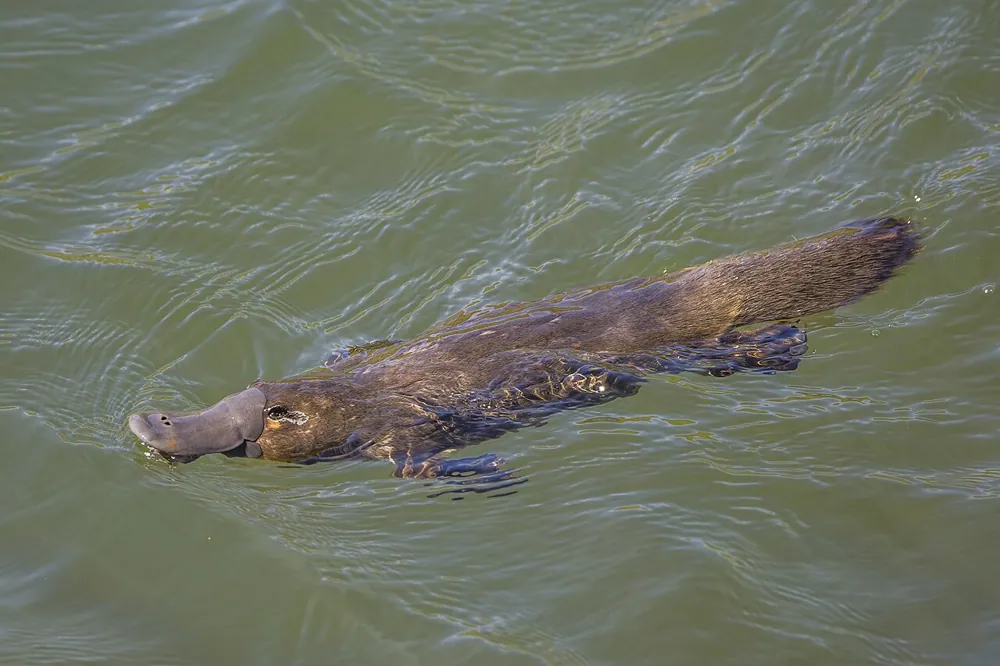
The platypus is a semiaquatic mammal that lays eggs, and it has a duck-like bill and a beaver-like tail. It lives in eastern Australia, including Tasmania. It is special because it is one of the few venomous mammals.1
🔍 How to recognise it
- Short, dense, brown fur that is waterproof1
- A soft, duck-like bill1
- A wide, flat, furry tail, unlike the scaly tail of a beaver1
- Short legs with webbing, most noticeably on the front feet1
- Small eyes and ears that sit in a groove that closes underwater1
Often confused with: Early European naturalists were confused by the platypus and thought it was a fake, made by sewing a duck's beak onto a beaver-like body. Its tail looks like a beaver's, but it is furry rather than scaly.1
Venom power
A sharp spur on its back legs carries the venom.
What does its venom do?
Only the male platypus has venom, which it injects through a spur on each hind foot. The text says the venom is powerful enough to cause extreme pain in humans. The affected limb then develops swelling, which starts at the wound and spreads.1
How dangerous is it to people?
Danger to people: PainfulIt can really hurt, but it is almost never serious.The text says the venom is extremely painful. It does not give bite numbers, deaths or how many people are harmed each year.1
🚑 If it bites or stings
- Wash the wound well and get medical help.
Always call your emergency number first (112, 000, 911). This is general first aid guidance, not medical advice. First aid basics
⛑️ Stay safe
- Never touch, catch or tease a wild animal, even a small one, and even if it looks asleep or dead.
- Give it space. If you meet one, stay calm, step back slowly and let it go its own way.
- If one bites or stings you: stay calm, keep still, call your emergency number (112, 000, 911) or get to a hospital fast. Remember what it looked like, a photo helps.
It is not out to get you. It uses its venom to catch food or to protect itself, and it would much rather hide. More about staying safe
Where in the world?
How big is it?
How long is it?
How heavy is it?
How big is Platypus compared to YOU?
Just maths in your browser. Nothing is saved or sent anywhere.
How fast is it?


Facts
The platypus has about 40,000 electroreceptors in its bill, which detect electric signals from prey in murky water.1
Its fur is one of the most densely packed of any mammal, behind only otters. It also glows cyan and green under ultraviolet light.1
The platypus lacks a functional stomach, because it does not have the genes needed to make pepsin, a digestive enzyme.1
Its average body temperature is about 32 °C, lower than the 37 °C typical of placental mammals.1
Adult platypuses have no teeth. They have heavily keratinised grinding pads instead, and young platypuses lose their teeth around the time they leave their burrow.1
Myth buster
Myth: The platypus is a hoax, made by sewing several animals together.
Truth: The platypus is a real species. When the first scientists examined a preserved body in 1799, they doubted it, and George Shaw even used scissors to check for stitches.1
For venom experts
- Scientific name
- Ornithorhynchus anatinus
- Group
- Venomous mammals
- Also called
- Duck-billed Platypus, Watermole, Duckbill1
- Family
- Ornithorhynchidae2
- Order
- Monotremata
- Continents
- Australia & Oceania
- Babies
- The platypus lays eggs instead of giving birth to live young. The text does not say how many eggs it lays.1
- How it is doing in the wild
- Near-threatened (IUCN). A November 2020 report recommended upgrading it to threatened under Australia's federal EPBC Act.1
- Danger to people
- 2 / 5: Painful3
Where the facts come from
- Platypus (Wikipedia (CC BY-SA 4.0))
- Ornithorhynchus anatinus (iNaturalist): names and classification.
- Venom Wiki: the danger level, the typical size and the speed guess are our own. See how we work them out: How we rate danger.
Every fact on this page has a number that points to its source. If we got something wrong, sorry, we are animal fans, not a science journal. Tell us at hello@venomwiki.app and we will fix it.
 The spider is hungry! Venom Wiki is a dad's project for his animal-loving kids, free with no ads and no trackers. Grown-ups can drop a snack in the basket to help keep it online.Feed the spider
 Common vampire bat
 Bengal slow loris
 Cuban solenodon
 Hispaniolan solenodon
 Javan slow loris
 Pygmy slow loris
 Coastal taipan
 Common death adder
 Eastern brown snake
 Inland taipan
 Sydney funnel-web spider
 Tiger snake
_Scottsdale.jpg)