
Eastern coral snake
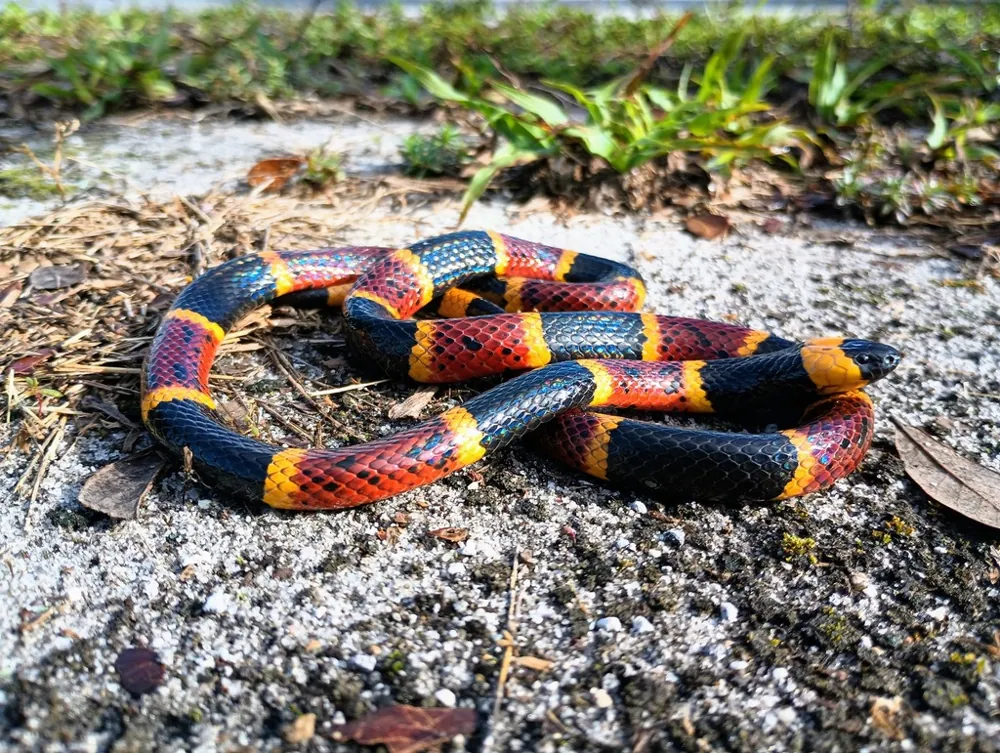
The eastern coral snake is a highly venomous snake with bright rings of red, yellow and black. It lives in the southeastern United States, including all of Florida. Its bright colours warn predators to keep away, and it is one of the snakes that people most need to recognise.1
🔍 How to recognise it
- Wide red and black rings are separated by narrow yellow rings all along the body.1
- The head is black from the snout to just behind the eyes, with a yellow band behind the eyes.1
- The red rings are usually speckled with black.1
- Adults are usually less than 80 cm long, including the tail.1
Often confused with: The scarlet snake and the scarlet kingsnake are nonvenomous mimics with similar colours. Kingsnakes and the scarlet snake are helpful predators of rats and mice, so the difference matters.1
Venom power
Venom comes out through its fangs or teeth when it bites.
What does its venom do?
The venom is a potent neurotoxin, which attacks the nerves. In humans, symptoms can include local pain, slurred speech, double vision, weakness and paralysis, and in severe cases breathing can fail. The text estimates that 5 mg of venom can be lethal to humans.1
How dangerous is it to people?
Danger to people: Very dangerousIt can kill a person who gets no treatment.Bites and deaths are very rare. Two deaths were documented in the 1950s, and one more has been reported since antivenin became available in the 1960s, the most recent in 2006. The snake is secretive and reluctant to bite, and the text estimates envenomation in only 40% of bites, though a 1987 study found 75%.1
💉 Good news: doctors have a medicine (antivenom) or a treatment for this.1
What does it do when it is scared?
When threatened it tries to escape, and if it cannot, it may hide its head under its coils, mimic the head with its tail, move erratically or feign death.1
🚑 If it bites or stings
- The text says the most recent victim died after failing to seek proper medical attention, so anyone bitten should get medical help straight away. Antivenom is available, according to the text.1
- Keep the person still and calm and get to a hospital fast, even if the bite looks small: symptoms can start hours later.
Always call your emergency number first (112, 000, 911). This is general first aid guidance, not medical advice. First aid basics
⛑️ Stay safe
- Never touch, catch or tease a wild animal, even a small one, and even if it looks asleep or dead.
- Give it space. If you meet one, stay calm, step back slowly and let it go its own way.
- If one bites or stings you: stay calm, keep still, call your emergency number (112, 000, 911) or get to a hospital fast. Remember what it looked like, a photo helps.
It is not out to get you. It uses its venom to catch food or to protect itself, and it would much rather hide. More about staying safe
Where in the world?
How big is it?
How long is it?
 as long as 2.5 house cats nose to tail🍌as long as 7 bananas end to end🏃could cover 100 metres in 73 seconds (the fastest human needs 9.6)
How big is Eastern coral snake compared to YOU?
Just maths in your browser. Nothing is saved or sent anywhere.
How fast is it?


Facts
An adult's venom can kill up to five adult humans, but the snake cannot release all of it in a single bite.1
Unlike New World pit vipers, the coral snake cannot control how much venom it injects.1
Males mature 11 to 16 months after hatching, while females take about 26 months.1
Coral snakes are mostly active during the day, and night sightings are rare.1
Coral snakes in Texas, western Louisiana and southeastern Arkansas are now considered a separate species, Micrurus tener.1
The range could expand up to 200 km northward because of climate change, according to future models.1
Myth buster
Myth: "Red and yellow, kill a fellow" is a reliable way to tell a venomous coral snake from a harmless mimic.
Truth: The rhyme is a folk saying that only applies to snakes in the southern United States, and it does not work anywhere else.1
For venom experts
- Scientific name
- Micrurus fulvius
- Group
- Coral snakes
- Also called
- American cobra, candy-stick snake, coral adder1
- Family
- Elapidae2
- Order
- Squamata
- Continents
- North America
- Babies
- Females lay between 3 and 12 eggs, usually in June, which hatch around September, and there is no parental care.1
- How it is doing in the wild
- Least Concern globally (IUCN, 2007), but of significant conservation concern locally, for example Endangered in North Carolina1
- Danger to people
- 4 / 5: Very dangerous3
Where the facts come from
- Micrurus fulvius (Wikipedia (CC BY-SA 4.0))
- Micrurus fulvius (iNaturalist): names and classification.
- Venom Wiki: the danger level, the typical size and the speed guess are our own. See how we work them out: How we rate danger.
Every fact on this page has a number that points to its source. If we got something wrong, sorry, we are animal fans, not a science journal. Tell us at hello@venomwiki.app and we will fix it.
 The spider is hungry! Venom Wiki is a dad's project for his animal-loving kids, free with no ads and no trackers. Grown-ups can drop a snack in the basket to help keep it online.Feed the spider
 Central American coral snake
 Texas coral snake
 Sonoran coral snake
 Allen's coral snake
 Brown's coral snake
 Dumeril's coral snake
 Terciopelo
 Eastern diamondback rattlesnake
 Eyelash viper
 Timber rattlesnake
 Western diamondback rattlesnake
 Arizona bark scorpion