
Deathstalker
The deathstalker is a yellow scorpion that lives in deserts and scrubland from North Africa across the Middle East to Central Asia. It is one of the most dangerous scorpions in the world, and its venom is being studied as a possible way to help treat brain tumours.1
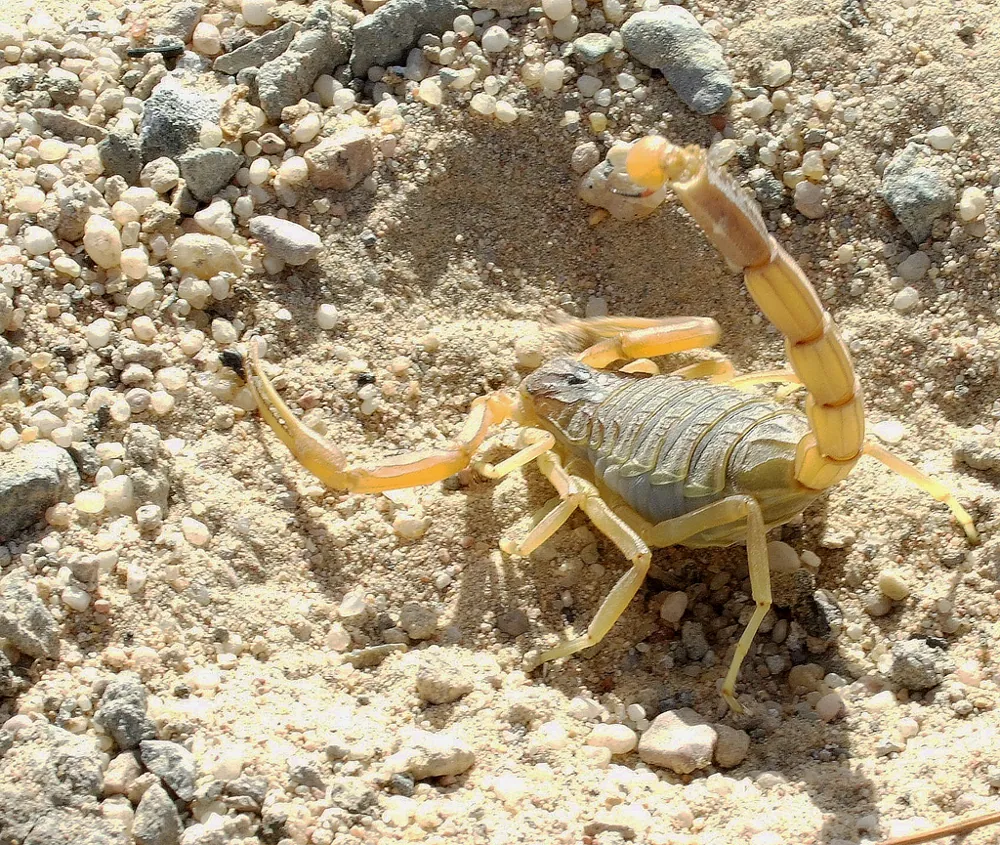
🔍 How to recognise it
Often confused with: Other species in the genus Leiurus are also called deathstalkers. In 2014 the subspecies L. q. hebraeus was made its own species, Leiurus hebraeus. The text does not describe how to tell these apart.1
Venom power
Venom comes out through a stinger.
What does its venom do?
The venom is a powerful mixture of neurotoxins, which attack the nerves. Its named components include chlorotoxin, charybdotoxin, scyllatoxin and agitoxins. A sting is extraordinarily painful. The text also notes a high rate of pancreatitis (inflammation of the pancreas) after envenomation, and that any sting carries a risk of anaphylaxis, a severe allergic reaction.1
How dangerous is it to people?
Danger to people: DeadlyOne of the most dangerous animals in the world.The deathstalker is one of the most dangerous scorpion species. Its venom has a low lethal dose, but a sting normally would not kill a healthy adult. Young children, elderly people and those who are infirm, such as people with heart conditions or allergies, are at much greater risk. If a sting proves deadly, the usual cause of death is pulmonary edema, which is fluid build-up in the lungs.1
💉 Good news: doctors have a medicine (antivenom) or a treatment for this.1
🚑 If it bites or stings
- Envenomation is considered a medical emergency, even with treatment. Antivenom exists, but the venom is unusually resistant to treatment and typically needs large doses. Medical help should be sought urgently.1
- Cool the sting with an ice pack and keep the person still. Get medical help fast, especially for children: some scorpions are deadly to kids.
Always call your emergency number first (112, 000, 911). This is general first aid guidance, not medical advice. First aid basics
⛑️ Stay safe
- Never touch, catch or tease a wild animal, even a small one, and even if it looks asleep or dead.
- Give it space. If you meet one, stay calm, step back slowly and let it go its own way.
- If one bites or stings you: stay calm, keep still, call your emergency number (112, 000, 911) or get to a hospital fast. Remember what it looked like, a photo helps.
It is not out to get you. It uses its venom to catch food or to protect itself, and it would much rather hide. More about staying safe
Where in the world?
How big is it?
How long is it?
How big is Deathstalker compared to YOU?
Just maths in your browser. Nothing is saved or sent anywhere.
How fast is it?

Facts
Its venom contains chlorotoxin, a peptide that has shown potential for treating human brain tumours.1
In 2015, clinical trials began on chlorotoxin with a fluorescent molecule attached, used as a brain tumour "paint" to mark cancer cells during surgery.1
In preclinical animal trials, the paint could highlight clusters of as few as 200 cancer cells, while the lower limit for standard MRI was above 500,000.1
There is some evidence that other venom components may help regulate insulin and could be used to treat diabetes.1
Antivenom is produced by AbbVie, Sanofi Pasteur and the National Antivenom and Vaccine Production Center in Riyadh.1
Outside its usual range, none of the existing antivenoms are approved by the US Food and Drug Administration, so they are only available as investigational drugs.1
Myth buster
Myth: A deathstalker sting always kills.
Truth: A sting normally would not kill a healthy adult, but young children, the elderly and people with certain health conditions are at much greater risk.1
Where the facts come from
- Deathstalker (Wikipedia (CC BY-SA 4.0))
- Leiurus quinquestriatus (iNaturalist): names and classification.
- Venom Wiki: the danger level, the typical size and the speed guess are our own. See how we work them out: How we rate danger.
Every fact on this page has a number that points to its source. If we got something wrong, sorry, we are animal fans, not a science journal. Tell us at hello@venomwiki.app and we will fix it.
 The spider is hungry! Venom Wiki is a dad's project for his animal-loving kids, free with no ads and no trackers. Grown-ups can drop a snack in the basket to help keep it online.Feed the spider
 Fat-tailed scorpion
 Emperor scorpion
 Indian red scorpion
 Arabian fat-tailed scorpion
 Transvaal thick-tailed scorpion
 Chinese scorpion
 Black mamba
 Egyptian cobra
 Puff adder
 Boomslang
 Gaboon viper
 Western honey bee